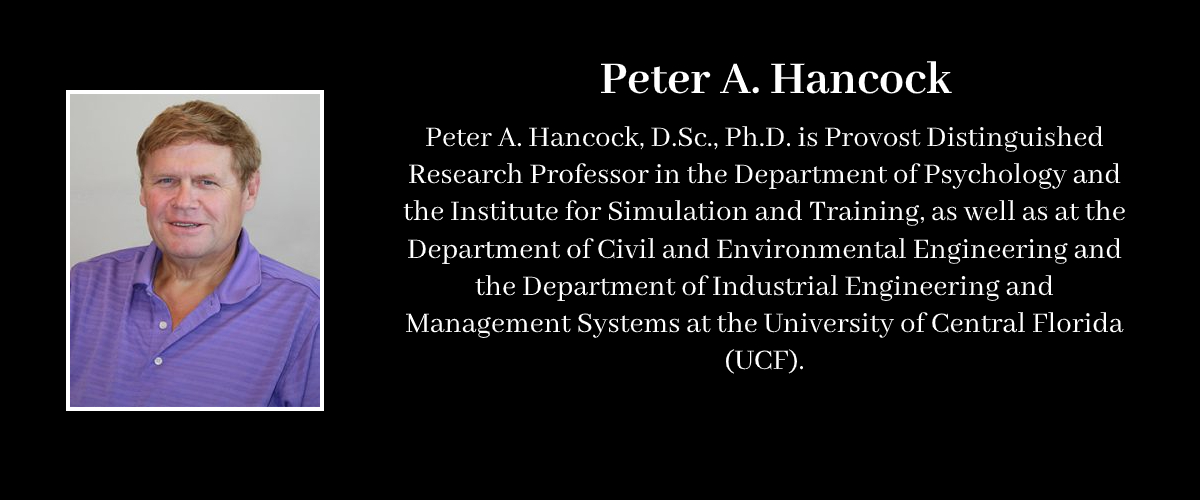
elcome to the personal Web site of Dr. Peter Hancock,
Provost's Distinguished Research Professor and head of the MIT² laboratory at the University of Central Florida.
Available from this site are all of Dr. Hancock's published articles, refereed publications, and book chapters. Also
available are videos of some of Dr. Hancock's presentations.
Dr. Hancock has authored over 400 refereed scientific articles and publications and has edited numerous books. His current experimental work concerns the evaluation of behavioral response to high-stress conditions. His theoretical work concerns human relations with technology and the possible futures of this symbiosis.
Please use the menu above to view Dr. Hancock's vitae, download copies of his articles, and learn more about Dr. Hancock and his work.
Visit Dr. Hancock's lab at the University of Central Florida, the MIT² lab.
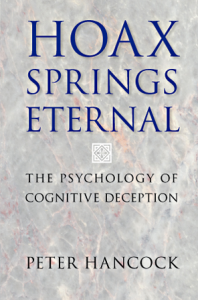
Cognitive Differences in the Ways Men and Women Experience the Dimension and Duration of Time: Contrasting Gaia and Chronos
This book argues that there are consistent temporal processing differences between the sexes and that these differences are of the same order of magnitude as the already known spatial processing differences. "Gaia and Chronos" is a treatise on the sensory and cognitive differences between the sexes in the dimension of time. Through descriptions of previous experiments relating to gender differences in the dimension of time, this work describes gender differences in the ability to accurately perceive time. In considering cognitive differences between the sexes, we have consistently neglected the dimension of time. Since time and space are inseparable companions, it would be incorrect to assume that reliable sex differences are evident only in spatial capabilities.
Richard the III and the Murder in the Tower
Richard III is accused of murdering his nephews—the "Princes in the Tower"—in order to usurp the throne of England. Since Tudor
times he has been painted as the "black legend," the murderous uncle. However, the truth is much more complicated and interesting. Rather than looking at all the killings
Richard III did not commit, this book focuses on the one judicial murder for which we know that he was responsible. On Friday, June 13, 1483, Lord Hastings was hustled from a meeting
of the Royal Council and summarily executed on Tower Green within the confines of the Tower of London. This book solves the mystery of this precipitate and unadvised action by the
then Duke of Gloucester and reveals the key role of William Catesby in Richard’s ascent to the throne of England. It explains his curious actions during that tumultuous summer of
three kings and provides an explanation for the fate of the "Princes in the Tower." Richard the III and the Murder in the Tower is available from Amazon and other booksellers.
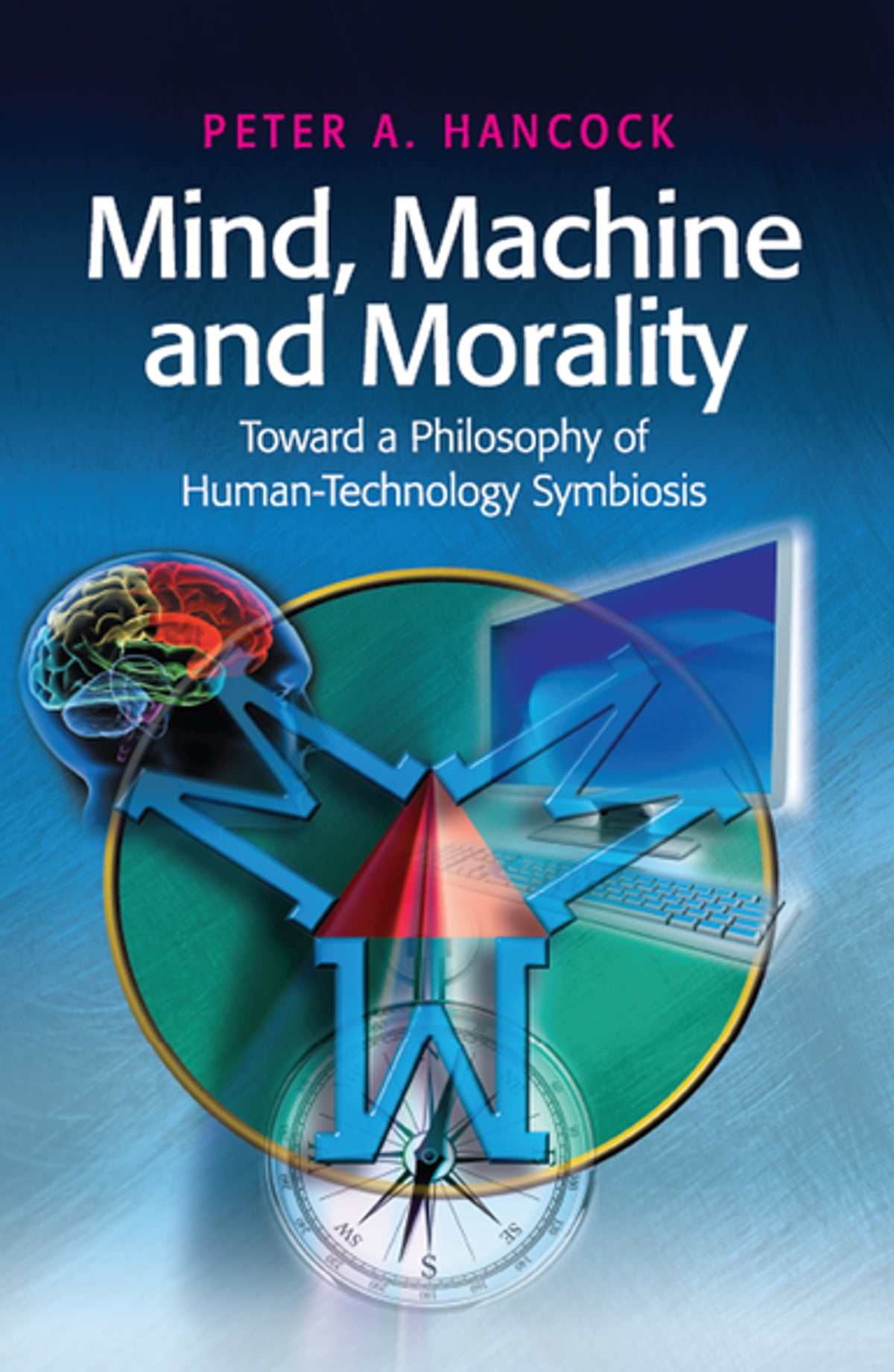
Mind, Machine and Morality
In Mind, Machine and Morality, Peter Hancock asks questions about this insensate progress and has the temerity to suggest some cognate answers. He argues for the unbreakable symbiosis of purpose and process, and examines the dangerous possibilities that emerge when science and purpose meet. Historically, this work is a modern-day child of Bacon’s hope for the ‘Great Instauration.’ However, unlike its forebear, the focus here is on human-machine systems. The emphasis centers on the conception that the active, extensive face of modern philosophy is technology. Whatever we are to become is bound up not only in our biology but critically in our technology also. And to achieve a rational progress we must express manifest purpose. This book is one step along the purposive road. More information about the book and ordering information is available from Ashgate Publishing. You can also download a printable description and order form.
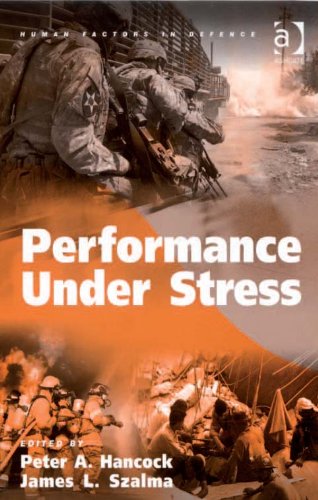
Performance Under Stress
Dr. Hancock and Dr. James Szalma have edited an upcoming book, Performance Under Stress.
The book is derived largely from a multiple-year, multiple university (MURI) project on stress and soldier
performance on the modern, electronic battlefield. The project involved leading researchers from multiple
institutions who have each brought their own individual expertise to bear on these crucial, contemporary concerns.
More information about the book and ordering information is available from
Ashgate Publishing You can also
download a printable description and order form.
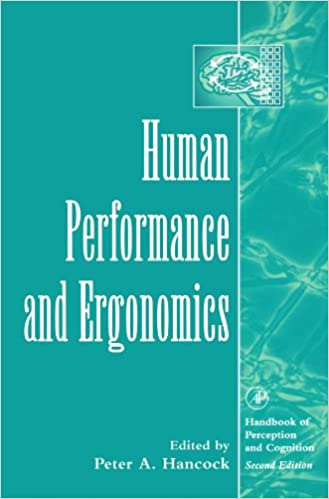
Human performance and Ergonomics
Human Performance and Ergonomics brings together a comprehensive and modern account of how the context of performance is crucial
to understanding behavior. Environment provides both constraints and opportunities to individuals, such that external conditions may have reciprocal or interactive effects on behavior.
The book begins with an account of research in human factors and engineering, with application of research to real world environments, methodological concerns, and rumination on
current and future trends. The book proceeds to how technology has moved from being designed to help human physical survival to helping humans achieve "quality of life"
improvements. Real world examples are explored in detail including hearing technology, driving, and aviation. Issues of control, maneuvering, and planning are discussed in conjunction
with how intention and expectancy affect behavior. The fit between human and environment is examined as a dynamic interaction, and many chapters address the all important human–machine
communication, particularly that between humans and computers. The book closes with a reminder that even our technological environment is filled with other people, with whom we must
interact personally or via technology, to achieve our larger goals. Teamwork is thus discussed for its integration of cognitive, behavioral, and affective components toward our
achieving desired aims. Human Performance and Ergonomics is available from Amazon and
other booksellers.